
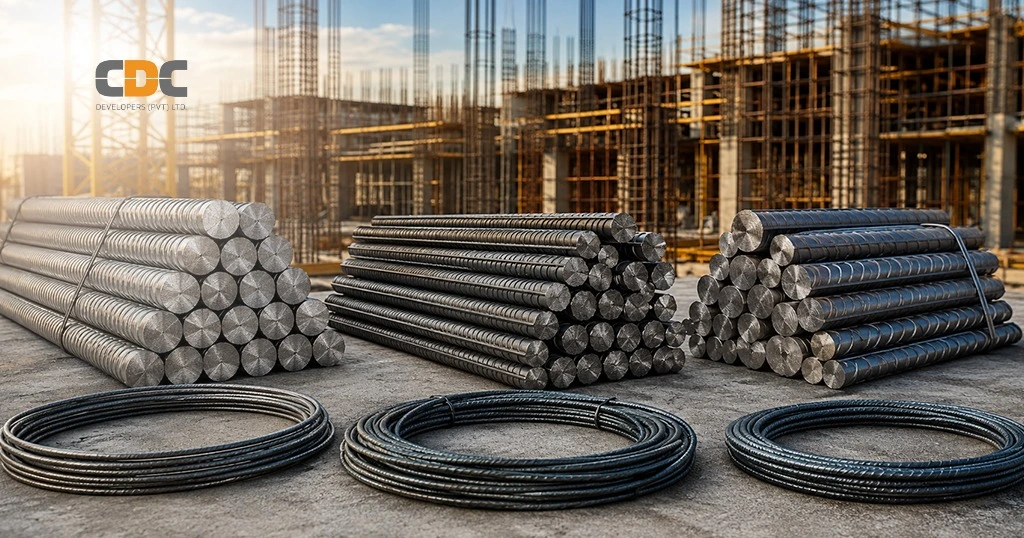
Steel is one of the most important materials used in reinforced concrete construction. It gives concrete the tensile strength it needs so that columns, beams, slabs and foundations can carry structural loads without failing.
Among the different steel grades used in the industry, Grade 40, Grade 60 and Grade 80 steel are the most commonly discussed. The main difference between these steel grades is their minimum yield strength, meaning the amount of stress the steel can handle before it starts to permanently deform.
Understanding these steel grades can help property buyers and construction professionals make sense of the materials used in modern buildings, and it also helps explain why the grade 60 steel price in Pakistan is often higher than that of lower grades.
What Does a Steel Grade Mean?
The grade of reinforcing steel generally tells you its minimum yield strength.
In simple terms:
- Grade 40: 40,000 psi (approximately 280 MPa)
- Grade 60: 60,000 psi (approximately 420 MPa)
- Grade 80: 80,000 psi (approximately 550 MPa)
A higher grade generally means the steel has a higher minimum yield strength. That said, a higher grade is not automatically the right choice for every building. The correct choice among these steel grades depends on structural calculations, building codes, reinforcement detailing and the specific requirements of the project.
What Is Grade 40 Steel?
Grade 40 steel has a minimum yield strength of 40,000 psi. It is the lightest of the common steel grades, sitting below Grade 60 and Grade 80 in terms of strength, and its workability is generally considered good, since it can be cut and bent with relative ease.
Grade 40 may be selected for light duty applications where the structural design does not call for higher strength reinforcement.
Characteristics of Grade 40 Steel
- Minimum yield strength of 40,000 psi
- Lower strength compared with Grade 60 and Grade 80
- Generally easy to bend and fabricate
- May require a larger quantity of steel to reach the same structural capacity as a higher strength grade
- Suitable only where specified by the structural design
What Is Grade 60 Steel?
Grade 60 steel has a minimum yield strength of 60,000 psi (approximately 420 MPa). Among all the steel grades available to builders, grade 60 steel is the one used most widely in reinforced concrete construction, largely because it strikes a practical balance between strength, workability, reinforcement efficiency and overall construction requirements.
Grade 60 steel can be used in many structural elements, including columns, beams, slabs, foundations, retaining walls and other reinforced concrete components, whenever specified by the structural engineer.
Characteristics of Grade 60 Steel
- Minimum yield strength of 60,000 psi
- Stronger than Grade 40
- Offers a good balance between strength and workability
- Widely used across reinforced concrete construction
- Can help reduce the required reinforcement area compared with Grade 40 in appropriately designed elements
- Suitable for many residential, commercial and multi story structures
What Is Grade 80 Steel?
Grade 80 steel has a minimum yield strength of 80,000 psi (approximately 550 MPa). Of the three common steel grades, it delivers the highest strength per unit area, which can allow engineers to achieve the required structural capacity using less reinforcement in certain applications.
Grade 80 steel can be particularly useful in heavily loaded structural elements or in situations where reinforcement congestion needs to be reduced. Even so, its use must always be based on proper engineering design and applicable building code requirements.
Characteristics of Grade 80 Steel
- Minimum yield strength of 80,000 psi
- Higher strength than Grade 40 and Grade 60
- Can provide greater reinforcement efficiency
- May help reduce reinforcement congestion in certain structural designs
- Requires careful engineering design, detailing and fabrication
Grade 40 vs Grade 60 vs Grade 80 Steel
| Feature | Grade 40 | Grade 60 | Grade 80 |
| Minimum Yield Strength | 40,000 psi | 60,000 psi | 80,000 psi |
| Approximate Yield Strength | 280 MPa | 420 MPa | 550 MPa |
| Relative Strength | Lower | High | Better |
| Workability | Generally easier | Good balance | Requires greater attention to fabrication |
| Reinforcement Efficiency | Lower; needs more steel volume | High; standard for most modern builds | Reduces total steel quantity needed |
| Typical Application | Selected light duty applications | Residential, commercial and multi story structures like high quality apartment complexes | High strength structural applications like dams and megastructures |
Which Grade of Steel Is Better?
There is no single answer among the available steel grades that works for every project. Grade 40, Grade 60 and Grade 80 each have different structural characteristics, and the right choice should always be based on the structural engineer’s calculations and the applicable construction standards.
For many reinforced concrete structures, grade 60 steel provides a practical combination of strength and workability, which is a large part of why it remains the most common choice among steel grades in residential and commercial construction. Grade 80 steel may be the better option where higher reinforcement strength is required, while Grade 40 steel may be appropriate for selected applications where lower strength reinforcement is enough.
The quality of steel should never be judged by its nominal grade alone. Material testing, certification, manufacturing quality, actual mechanical properties and compliance with applicable standards are all equally important factors.
Grade 60 Steel Price in Pakistan
Because grade 60 steel is the most commonly used reinforcement in Pakistan’s residential and commercial construction, the grade 60 steel price in Pakistan is one of the most frequently tracked figures in the local construction market.
Through 2026, market reports have placed the grade 60 steel price in Pakistan somewhere in the range of roughly PKR 220,000 to PKR 270,000 per ton, or approximately PKR 220 to PKR 265 per kilogram, with the exact figure shifting from month to month, city to city, and dealer to dealer. Some listings have reported ton prices closer to the lower end of this range, while others, particularly for premium certified brands, have quoted figures near the upper end. This kind of variation is normal in the local steel market and is one more reason buyers should always confirm same day rates before finalizing a purchase.
A few factors generally influence the grade 60 steel price in Pakistan at any given time:
- Brand and manufacturer, since certified mills such as Amreli, Mughal, Batala and Hamza Steel are typically priced differently from smaller, uncertified producers
- City and location, since transportation costs and dealer margins create small regional differences between cities such as Lahore and Karachi
- Raw material costs and currency exchange rates, since steel production depends heavily on imported scrap and billets
- Energy and fuel costs, which affect manufacturing and transport expenses
- Overall construction demand, including housing and infrastructure activity across the country
Because these figures change frequently, anyone budgeting a project should confirm the current grade 60 steel price in Pakistan directly with a certified dealer or manufacturer before finalizing a construction budget.
Why Does CDC Developers Use Grade 60 Steel?
At CDC Developers, material quality and structural strength are important considerations in the development of our apartment projects. Our apartment projects use grade 60 steel as part of their reinforced concrete structural system, in line with each project’s engineering and construction requirements.
Among all the steel grades on the market, grade 60 steel offers a strong balance between structural strength, workability and reinforcement efficiency, which is why it remains such a widely used choice in reinforced concrete construction.
There is another important point to understand when evaluating the quality of reinforcing steel: the actual tested strength can be, and often is, higher than the minimum strength required for its grade.
Grade 60 Steel Can Test Above 60,000 psi
Grade 60 means that the steel has a minimum yield strength of 60,000 psi. It does not mean that every test result will land exactly at 60,000 psi.
For example, if a properly conducted material test shows a yield strength of approximately 62,000 to 64,000 psi, that simply means the tested steel has exceeded the 60,000 psi minimum requirement for its grade.
So if grade 60 steel used on a project tests at 62,000 psi or 64,000 psi, it should still be described as grade 60 steel. The 62,000 to 64,000 psi figure represents the actual tested yield strength, not a separate Grade 62 or Grade 64 classification.
This distinction matters when discussing steel quality, because it shows how actual test results can exceed the minimum specified requirement for any of the standard steel grades.
At CDC Developers PVT. Ltd. our tested steel usually lands above 60,000 psi in almost all PCSIR Tests, ensuring the highest construction quality standards are maintained.
How Does Steel Quality Contribute to a Building?
The performance of a reinforced concrete building depends on far more than which of the available steel grades was chosen. Several factors work together, including:
- Quality of the reinforcing steel
- Actual material test results
- Concrete strength and quality
- Structural engineering and calculations
- Correct reinforcement placement
- Proper bar spacing and detailing
- Construction workmanship
- Quality control during construction
- Compliance with applicable building codes and standards
At CDC Developers, using grade 60 steel is part of a broader approach to structural construction that combines the right materials with sound engineering and construction practices.
For apartment buyers, this means evaluating a building should go well beyond simply asking which steel grade was used. The quality of the material, its testing, the structural design and the construction execution all matter just as much.
Final Thoughts
The main difference between Grade 40, Grade 60 and Grade 80 steel comes down to their minimum yield strength. Grade 40 has a minimum yield strength of 40,000 psi, Grade 60 has 60,000 psi, and Grade 80 has 80,000 psi.
Among all the steel grades commonly used in reinforced concrete construction, grade 60 steel offers a practical balance of strength and workability, which is why CDC Developers uses grade 60 steel in its apartment projects. Where material testing shows values such as 62,000 to 64,000 psi, those results simply indicate yield strength above the 60,000 psi minimum associated with Grade 60.
Buyers who are comparing the grade 60 steel price in Pakistan across brands and dealers should remember that price alone does not tell the whole story. Ultimately, the strength and quality of a building depend on the complete structural system, not on steel grade or price alone. Proper engineering, quality materials, testing, detailing and sound construction practices all contribute to a building’s long term performance and at CDC Developers there is no compromise in this matter ensuring a reliable product and a satisfied patron.