
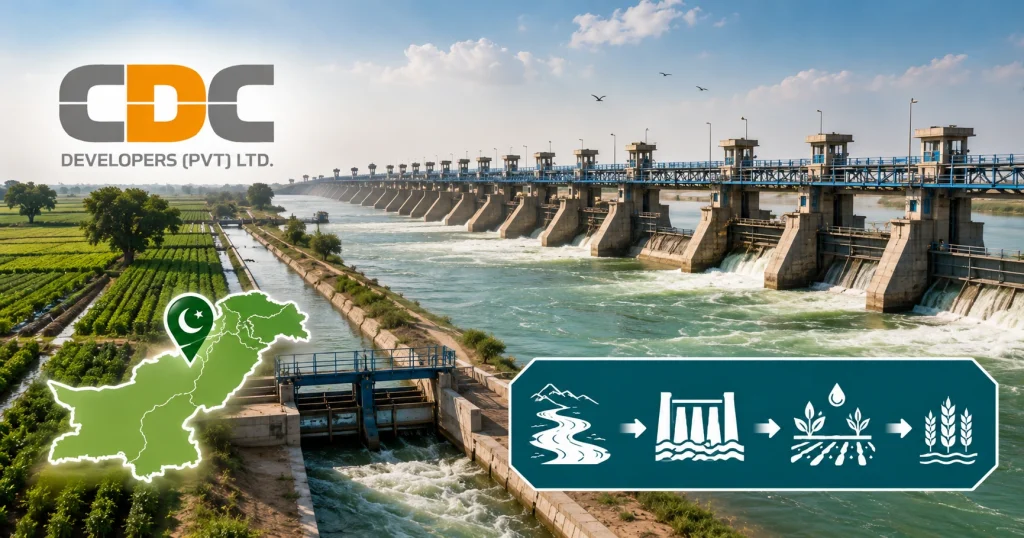
Pakistan is home to one of the largest and most complex irrigation systems in the world, and at the heart of this system lies a network of barrages spread across the country’s major rivers. These engineering structures have transformed vast stretches of arid land into productive farmland, feeding millions of people and sustaining the agricultural backbone of the nation. From the mighty Indus River to the Chenab and Jhelum, barrages in Pakistan play a vital role in regulating water flow, controlling floods, and channeling water to crops across Punjab, Sindh, and beyond. In this complete guide, you will find everything you need to know about barrages in Pakistan, including their locations, history, engineering features, irrigation canals, and the challenges they face in the modern era.
What Are Barrages in Pakistan?
A barrage is a type of low-head dam constructed across a river to raise the water level so that water can be diverted into canals for irrigation, drinking, and industrial use. Unlike a large storage dam, a barrage does not hold back vast quantities of water. Instead, it controls and regulates the flow of river water through a series of gates. In Pakistan, barrages form the lifeline of the country’s irrigation network and are essential for distributing water across millions of acres of agricultural land.
Barrages in Pakistan are especially critical because the country relies heavily on river water for farming. The Indus River system, which includes the Indus, Jhelum, Chenab, Ravi, Sutlej, and Beas rivers, supplies water to the entire irrigation network. Barrages are the key structures that make this distribution possible.
How Does a Barrage Work?
A barrage works by using a series of adjustable gates installed across the width of a river. When the gates are lowered, the water level upstream rises, creating a pond or reservoir effect. This raised water level is then used to push water into irrigation canals located on either side of the river. When floods occur, the gates can be opened fully to allow excess water to flow downstream, preventing flooding in surrounding areas.
The gates of a barrage are typically made of steel and are operated either manually or mechanically. Engineers monitor water levels continuously and adjust the gates based on seasonal needs, flood conditions, and canal water requirements. The entire system is carefully managed to ensure that water reaches farms efficiently throughout the year.
Main Functions of a Barrage
Barrages in Pakistan serve several important purposes that go beyond simple water diversion. The primary function is irrigation, which involves directing river water into a system of canals that carry it to agricultural fields. This ensures that crops receive a steady water supply even during dry seasons when river flow is naturally low.
Flood control is another major function. During the monsoon season, rivers in Pakistan can swell to dangerous levels. Barrages help manage this excess water by controlling how much flows downstream, reducing the risk of catastrophic flooding in populated areas.
Water diversion is central to the barrage’s design. By raising the water level and directing flow into specific canals, a barrage ensures that water reaches the right places at the right times. Navigation support is also provided in some locations, as the raised water level makes rivers more navigable for small boats and transport vessels.
How Many Barrages in Pakistan?
Pakistan has a total of approximately 23 major barrages and headworks spread across its river systems. These structures were developed over more than a century, with many built during British colonial rule and others constructed after Pakistan’s independence in 1947. The barrage network continues to be expanded and modernized to meet the growing water demands of a rising population.
The development of barrages in Pakistan began in earnest in the late 19th century when British engineers recognized the agricultural potential of the Indus basin. The construction of these structures transformed what were largely desert regions into fertile agricultural zones. After independence, Pakistan continued to invest in barrage infrastructure, adding new structures and rehabilitating existing ones.
Distribution of Barrages by Province
Punjab has the highest number of barrages, reflecting its status as Pakistan’s agricultural heartland. Major barrages in Punjab include Trimmu, Panjnad, Islam, Suleimanki, Balloki, and several headworks on the upper portions of the river system. These structures irrigate millions of acres of land and support the production of wheat, rice, sugarcane, and cotton.
Sindh is the second most important province in terms of barrage infrastructure. Three major barrages, namely Sukkur, Guddu, and Kotri, serve Sindh’s vast agricultural plains. These barrages are especially important because Sindh is located at the lower end of the Indus River system and depends heavily on upstream water management.
Khyber Pakhtunkhwa has a smaller but still significant barrage network, including the Chashma Barrage on the Indus River. Balochistan has limited barrage infrastructure due to its different geographical and hydrological characteristics, but it benefits from water diverted through canals originating from barrages in Sindh and Punjab.
Distribution of Barrages by River System
The Indus River has the greatest number of barrages, including Jinnah, Chashma, Taunsa, Guddu, Sukkur, and Kotri. These barrages span the entire length of the Indus as it flows from Punjab down through Sindh to the Arabian Sea.
The Chenab River hosts barrages such as Trimmu and Panjnad, both of which are crucial for irrigating central and southern Punjab. The Jhelum River system supports headworks like Rasul and Trimmu, which feed into Punjab’s canal network. The Sutlej River has barrages including Islam and Suleimanki, which are important for irrigating southern Punjab.
List of Major Barrages in Pakistan
Pakistan’s barrage network represents one of the most ambitious water management achievements in the developing world. Each barrage has its own unique history, engineering characteristics, and agricultural significance.
Major Barrages at a Glance
| Barrage Name | River | Province | Year Built | Main Function |
| Jinnah Barrage | Indus | Punjab | 1946 | Irrigation, Flood Control |
| Chashma Barrage | Indus | Punjab | 1971 | Irrigation, Navigation |
| Taunsa Barrage | Indus | Punjab | 1958 | Irrigation, Flood Control |
| Guddu Barrage | Indus | Sindh | 1962 | Irrigation |
| Sukkur Barrage | Indus | Sindh | 1932 | Irrigation |
| Kotri Barrage | Indus | Sindh | 1955 | Irrigation, Water Supply |
| Trimmu Barrage | Chenab/Jhelum | Punjab | 1939 | Irrigation |
| Panjnad Barrage | Chenab | Punjab | 1932 | Irrigation |
| Islam Barrage | Sutlej | Punjab | 1927 | Irrigation |
| Suleimanki Barrage | Sutlej | Punjab | 1927 | Irrigation |
| Balloki Barrage | Ravi | Punjab | 1913 | Irrigation |
| Rasul Barrage | Jhelum | Punjab | 1967 | Irrigation |
Barrages on Indus River
The Indus River is the most important waterway in Pakistan and serves as the backbone of the entire national irrigation system. Flowing approximately 3,180 kilometers from its source in the Tibetan Plateau through Ladakh and then across Pakistan to the Arabian Sea, the Indus carries enormous volumes of water that are essential for agriculture across both Punjab and Sindh. The barrages constructed on the Indus River are among the most significant engineering achievements in South Asian history.
The Indus River barrages collectively irrigate tens of millions of acres of agricultural land, making Pakistan one of the top agricultural producers in the region. Without these barrages, vast stretches of Sindh and southern Punjab would remain arid and unproductive.
How Many Barrages on Indus River?
There are six major barrages on the Indus River in Pakistan. From north to south, these are the Jinnah Barrage, Chashma Barrage, Taunsa Barrage, Guddu Barrage, Sukkur Barrage, and Kotri Barrage. Each of these structures plays a distinct role in the management of Indus River water as it flows toward the sea.
Major Indus River Barrages
The Jinnah Barrage, also known as the Kalabagh Barrage, is located near Kalabagh in Punjab. It was completed in 1946 and serves as the northernmost major barrage on the Indus. Its primary purpose is to divert water into the Thal Canal, which irrigates the Thal Desert region.
The Chashma Barrage is located near Dera Ismail Khan in Khyber Pakhtunkhwa. Completed in 1971, it is one of the more modern barrages on the Indus and feeds water into the Chashma Right Bank Canal and the Chashma Jhelum Link Canal. It also supports navigation along the river.
The Taunsa Barrage is situated near Dera Ghazi Khan in Punjab. Built in 1958, it is an important structure for irrigating the arid regions of southern Punjab and also plays a vital role in flood control during the monsoon season.
The Guddu Barrage is located near Kashmore in northern Sindh. Completed in 1962, it feeds three major canals and provides irrigation water to large areas of both Sindh and Balochistan.
The Sukkur Barrage, the most famous barrage in Pakistan, is located at Sukkur in Sindh. Completed in 1932, it was the largest irrigation barrage in the world at the time of its construction.
The Kotri Barrage is the southernmost barrage on the Indus, located near Hyderabad in Sindh. Completed in 1955, it is the last major control point on the river before it empties into the Arabian Sea.
Barrages in Sindh
Sindh is Pakistan’s second largest province and relies almost entirely on the Indus River for its agricultural water supply. The province receives very little rainfall and would be largely uninhabitable without its extensive canal irrigation system fed by three major barrages. Agriculture in Sindh supports millions of farming families and contributes significantly to the national economy through the production of cotton, rice, wheat, and sugarcane.
The barrages in Sindh not only support agriculture but also provide drinking water to urban centers including Karachi, Hyderabad, and Sukkur. They also support the livelihoods of fisherfolk and other communities dependent on river ecosystems.
How Many Barrages in Sindh?
There are three major barrages in Sindh: Sukkur Barrage, Guddu Barrage, and Kotri Barrage. All three are located on the Indus River and together irrigate millions of acres of farmland. These barrages collectively represent the most critical water infrastructure in Sindh and are considered national assets of the highest importance.
Sukkur Barrage
The Sukkur Barrage is located at the city of Sukkur in Sindh Province. It spans the Indus River at a point where the river passes through a narrow gorge, making it an ideal location for water control. The barrage was constructed by the British colonial administration and completed in 1932. It is considered one of the greatest engineering achievements of its era and is still a major source of irrigation water for Sindh.
Guddu Barrage
The Guddu Barrage is situated near Kashmore in the northern part of Sindh, close to the border with Punjab. It was completed in 1962 and serves as an important link between the irrigation systems of Punjab and Sindh. The barrage feeds three major canals and provides water to a large agricultural area.
Kotri Barrage
The Kotri Barrage, also known as the Ghulam Muhammad Barrage, is located near Hyderabad in Sindh. It was completed in 1955 and is the last barrage on the Indus before the river reaches the delta and flows into the Arabian Sea. The Kotri Barrage is vital for maintaining minimum water flows in the lower Indus and for protecting the delta ecosystem.
Sukkur Barrage – Largest Barrage of Pakistan
The Sukkur Barrage holds the distinction of being the largest barrage in Pakistan. When it was completed in 1932, it was also the largest irrigation barrage in the entire world. The sheer scale of this structure and the vast irrigation network it supports make it one of the most important pieces of infrastructure in the entire country.
The barrage was commissioned by the Government of Bombay under British rule and was designed by the renowned engineer Sir Arnold Cotton. Its construction took several years and involved the labor of thousands of workers. Upon completion, it opened up millions of acres of previously unproductive land in Sindh for agriculture.
Sukkur Barrage Location
The Sukkur Barrage is located at the city of Sukkur in Sindh Province, approximately 500 kilometers north of Karachi. At this location, the Indus River passes through a narrow rocky gorge between the cities of Sukkur and Rohri, which provided the ideal natural conditions for constructing a barrage. The rocky banks gave the structure a firm foundation and reduced construction costs significantly.
Engineering Features of Sukkur Barrage
The Sukkur Barrage is an impressive engineering structure by any measure. It is approximately 1,524 meters (about 5,000 feet) long and spans the full width of the Indus River at this point. The barrage has 66 gates, each measuring 18 meters in width, which can be raised or lowered to control water flow with great precision.
The design discharge capacity of the Sukkur Barrage is approximately 1,500,000 cubic feet per second during peak flood conditions. This enormous capacity allows it to handle the massive flood flows that occur during the monsoon season without causing damage to surrounding areas.
Names of 7 Canals of Sukkur Barrage
The Sukkur Barrage feeds a network of seven major canals that distribute water across Sindh. Together, these canals irrigate approximately 7.6 million acres of agricultural land, making Sukkur’s canal system one of the largest in the world.
Nara Canal
The Nara Canal is the longest canal fed by the Sukkur Barrage and runs along the eastern side of Sindh. It irrigates a vast area in the districts of Khairpur, Sukkur, Sanghar, Mirpurkhas, and Tharparkar. The canal is approximately 298 miles long and is one of the most important waterways in Sindh.
Rohri Canal
The Rohri Canal flows eastward from the barrage and provides irrigation water to areas on the left bank of the Indus. It serves the districts of Sukkur, Khairpur, and Sanghar. The Rohri Canal is one of the major canals in the Sukkur system and is vital for the cultivation of rice and other crops.
Rice Canal
The Rice Canal, as its name suggests, primarily supports the cultivation of rice in the areas it serves. It flows from the Sukkur Barrage and irrigates portions of Sindh where conditions are suitable for paddy cultivation. Rice from these areas is an important part of Pakistan’s agricultural output.
Dadu Canal
The Dadu Canal flows westward from the barrage and provides water to the Dadu district on the right bank of the Indus. This canal irrigates a significant area and supports the agricultural economy of this part of Sindh.
North Western Canal
The North Western Canal is located on the right bank of the Indus and provides irrigation water to the northern and western parts of the Sukkur barrage command area. It supports the cultivation of various crops in districts that would otherwise receive very little water.
Khairpur East Canal
The Khairpur East Canal serves the eastern portions of Khairpur district and is an important source of irrigation water for this area. It branches off from the Sukkur Barrage system and provides water to agricultural land in this productive region of Sindh.
Khairpur West Canal
The Khairpur West Canal covers the western portions of Khairpur district and complements the Khairpur East Canal in providing comprehensive irrigation coverage to this district. Together, these two canals ensure that the entirety of Khairpur’s agricultural land receives adequate water supply.
Guddu Barrage Location and Engineering Facts
The Guddu Barrage is one of the three major barrages in Sindh and serves as a critical link in Pakistan’s water management infrastructure. It was designed and built in the post-independence era and represents a significant achievement in Pakistani engineering.
Where Is Guddu Barrage Located?
The Guddu Barrage is located near the town of Kashmore in the Kashmore District of northern Sindh, close to the border between Sindh and Punjab. It sits on the Indus River at a strategic point where the river transitions from Punjab to Sindh. This location makes Guddu Barrage particularly important for managing water distribution between the two provinces.
Key Engineering Specifications
The Guddu Barrage was completed in 1962 and has a total length of approximately 1,350 meters. It has 64 gates that control the flow of the Indus River. The barrage has a design discharge capacity of around 1,200,000 cubic feet per second, which is sufficient to handle significant flood flows during the monsoon season.
Three major canals draw water from the Guddu Barrage: the Guddu Canal on the right bank, the Begari Canal, and the Desert Pat Feeder Canal. These canals distribute water to large areas of Sindh and also provide irrigation to parts of Balochistan.
Economic and Agricultural Importance
The Guddu Barrage irrigates approximately 2.8 million acres of agricultural land, making it an extremely important structure for food production. It supports the cultivation of cotton, wheat, rice, and sugarcane across a wide area. The barrage also provides water to communities along its canal network and contributes significantly to the local economy.
Which Is the 2nd Largest Barrage of Pakistan?
The Taunsa Barrage holds the distinction of being the second largest barrage in Pakistan. Located near Dera Ghazi Khan on the Indus River in Punjab, the Taunsa Barrage was completed in 1958 and has since played a vital role in irrigating southern Punjab and controlling floods in the region.
Compared to the Sukkur Barrage, the Taunsa Barrage is slightly smaller in overall dimensions but still represents a massive engineering structure. It has a total length of approximately 1,524 meters and contains 57 gates for water flow regulation. Its design discharge capacity allows it to handle very large volumes of water during peak flood season.
The Taunsa Barrage feeds two major canals: the Taunsa Punjnad Link Canal and the Muzaffargarh Canal, which together irrigate hundreds of thousands of acres across the Dera Ghazi Khan and Muzaffargarh districts of Punjab. The barrage also serves a critical flood protection function, helping to manage the highly variable flow of the Indus during monsoon periods.
Oldest Barrage of Pakistan
The Balloki Barrage on the Ravi River holds the distinction of being among the oldest barrage structures in Pakistan. However, when considering the broader category of headworks and barrages in the Indus basin, the Upper Chenab Canal Headworks at Marala, completed in 1913, is often cited as one of the earliest major water control structures in what is now Pakistan. The Islam Barrage on the Sutlej River, dating back to 1927, is also considered one of the pioneering barrages of the region.
History and Construction
The development of water control structures in the Indus basin began under British colonial administration in the late 19th and early 20th centuries. British engineers undertook ambitious projects to unlock the agricultural potential of the Punjab plains by constructing canals fed by headworks on the major rivers. These early structures were built with the technology and materials available at the time, using stone masonry and iron gates.
The construction of these structures required enormous human effort and engineering ingenuity. Teams of engineers and thousands of laborers worked in difficult conditions to build these foundations of Pakistan’s agricultural economy.
Current Importance
Despite their age, many of Pakistan’s oldest barrages and headworks continue to function and serve their irrigation purpose. They have undergone various repairs and upgrades over the decades but retain their fundamental structure and role. The continued operation of these older structures is a testament to the quality of their original construction and the importance of ongoing maintenance.
Smallest Barrage of Pakistan
Among Pakistan’s major barrages, the Kotri Barrage on the Indus River near Hyderabad is often considered one of the smaller structures in terms of gate count and overall length compared to giants like Sukkur and Taunsa. However, in terms of purpose and importance, the Kotri Barrage is anything but minor.
The Kotri Barrage has a length of approximately 915 meters and contains 44 gates. While these dimensions make it physically smaller than most other major barrages on the Indus, its strategic location as the last barrage before the Indus delta gives it unique importance. It helps maintain minimum water flows in the lower Indus, which is essential for the health of the Indus delta ecosystem and the communities that depend on it.
The Kotri Barrage also supplies water to Hyderabad and supports irrigation in the lower Sindh region. Its role in water supply and environmental flow management makes it an essential component of the national water infrastructure despite its relatively compact size.
Barrages on Chenab River
The Chenab River is one of the five major rivers of the Indus basin and flows through the heart of Punjab before merging with the Sutlej at Panjnad. It is an important source of irrigation water for central Punjab and has been the site of significant barrage construction over the past century. The Chenab barrages contribute substantially to Punjab’s agricultural productivity.
Trimmu Barrage
The Trimmu Barrage is located at the confluence of the Chenab and Jhelum rivers in Punjab. It was completed in 1939 and serves as a critical junction in the Punjab irrigation network. At Trimmu, water from both the Chenab and Jhelum rivers is controlled and distributed into canals that serve large areas of central Punjab. The barrage has a significant number of gates and manages the combined flow of two major rivers, making it a complex and important engineering structure.
Panjnad Barrage
The Panjnad Barrage is located at Panjnad, the point where all five rivers of the Punjab, namely the Jhelum, Chenab, Ravi, Beas, and Sutlej, merge before flowing into the Indus. Completed in 1932, the Panjnad Barrage controls the combined flow of these rivers and diverts water into the Panjnad Canal system that irrigates the southern tip of Punjab. It is a historically and strategically significant structure.
Irrigation Benefits of Chenab River Barrages
The barrages on the Chenab River collectively irrigate millions of acres of agricultural land in Punjab, supporting the cultivation of wheat, cotton, sugarcane, and rice. The canal systems fed by the Trimmu and Panjnad barrages extend across multiple districts and form an integral part of Punjab’s agricultural infrastructure. Without these barrages, large areas of central and southern Punjab would be significantly less productive.
Barrage and Headworks – Understanding the Difference
The terms barrage and headworks are often used interchangeably in Pakistan, but they refer to structures with somewhat different characteristics. Understanding the distinction between a barrage and headworks helps in appreciating how Pakistan’s irrigation system is organized and managed.
What Is a Headworks?
A headworks is a structure built at the head, or upstream point, of a canal system to divert and regulate water from a river into canals. A headworks may or may not span the full width of the river. In many cases, headworks are smaller structures that simply provide a controlled intake for a specific canal or group of canals. Historically, many of Pakistan’s early water control structures were referred to as headworks because they were the starting points of canal systems.
Difference Between Head and Barrage
The key difference between a headworks and a barrage lies in scale and function. A barrage spans the entire width of the river and has a series of gates along its entire length that allow comprehensive control of river flow. A headworks typically serves a more limited purpose and may only regulate the intake to one or a few canals. A barrage provides much greater control over river flow and can be used for both irrigation diversion and flood management, while a headworks is primarily focused on canal intake regulation.
Barrage vs Headworks Comparison Table
| Feature | Barrage | Headworks |
| Span | Full width of river | Partial or full width |
| Gate System | Multiple gates across full span | Fewer gates, focused on intake |
| Primary Function | Irrigation + Flood Control | Canal water intake |
| Scale | Large structure | Smaller structure |
| Water Level Control | Comprehensive | Limited |
| Flood Management | Yes | Limited |
| Example | Sukkur Barrage | Balloki Headworks |
Importance of Barrages in Pakistan’s Agriculture
Agriculture is the foundation of Pakistan’s economy, employing a large portion of the workforce and contributing significantly to the national GDP. Barrages in Pakistan are the key structures that make large-scale agriculture possible in what would otherwise be semi-arid and arid regions. Without the water diverted by barrages, Pakistan’s agricultural output would be a fraction of what it is today.
The canal systems fed by Pakistan’s barrages irrigate approximately 18 million hectares of agricultural land, making Pakistan’s irrigated area one of the largest in the world. This irrigation infrastructure supports the production of major crops that feed the population and generate export revenue.
Support for Major Crops
Wheat, which is Pakistan’s staple food, is grown extensively across the irrigated plains of Punjab and Sindh, with water supplied by barrages. Cotton, which is one of Pakistan’s most important cash crops and the foundation of its textile industry, also depends heavily on canal irrigation from barrages. Rice, sugarcane, maize, and a wide variety of fruits and vegetables are also cultivated across the barrage command areas.
The productivity of these crops depends directly on the reliable and timely delivery of irrigation water, which is made possible by the country’s barrage infrastructure. A failure in the barrage system can lead to crop losses, food shortages, and economic hardship for millions of farming families.
Irrigation Network Development
Pakistan’s barrage system has supported the development of one of the most extensive irrigation networks in the world. The canals fed by barrages branch out into an intricate system of distributaries and watercourses that carry water to individual farms. This network has been continuously expanded and refined over more than a century and now covers virtually every cultivable area of the Indus basin.
Rural Economic Growth
The irrigation water provided by Pakistan’s barrages has been the primary driver of rural economic development in the country. Agricultural productivity made possible by barrage irrigation has raised living standards in rural areas, generated employment, and supported the growth of agro-based industries. Towns and cities in the barrage command areas have grown and prospered on the back of agricultural wealth generated by reliable irrigation water.
Challenges Facing Barrages in Pakistan
Despite their enormous importance, barrages in Pakistan face a range of serious challenges that threaten their long-term functionality and the agricultural productivity they support. Addressing these challenges requires significant investment, technical expertise, and coordinated government action.
Sediment Accumulation
One of the most significant challenges facing Pakistan’s barrages is sedimentation. The rivers of the Indus basin carry enormous quantities of silt and sediment, which deposit on the riverbeds and in front of barrage gates over time. This sediment accumulation reduces the water storage capacity upstream of barrages, clogs gates, and reduces the efficiency of water diversion into canals. Sediment removal is a continuous and costly process that requires specialized equipment and skilled labor.
Structural Deterioration
Many of Pakistan’s barrages are old structures that were built during the colonial era or in the early decades after independence. After 70 to 90 years of continuous operation, these structures are showing signs of structural deterioration. Concrete is cracking, steel gates are corroding, and foundation materials are weakening. The cost of rehabilitating and upgrading these aging structures is very high, and delays in maintenance can lead to sudden failures that disrupt irrigation to millions of acres.
Water Scarcity and Climate Change
Pakistan is facing growing water scarcity due to population growth, increased agricultural demand, and the impacts of climate change. Glacial retreat in the Himalayas is changing the seasonal pattern of river flows, bringing more erratic floods and more severe dry periods. Barrages designed for historical flow patterns are now being challenged by more extreme conditions. Rising temperatures are also increasing evaporation from canal systems, reducing the efficiency of water delivery to farms.
Future of Barrages in Pakistan
The future of Pakistan’s barrage infrastructure is a topic of significant national importance. The government and various development agencies are investing in the rehabilitation and modernization of existing barrages while also exploring new approaches to water management that can meet the challenges of the 21st century.
Ongoing Modernization Projects
Several major rehabilitation projects are currently underway or in the planning stages for Pakistan’s aging barrages. These projects involve replacing old steel gates with modern hydraulic systems, repairing cracked concrete structures, dredging accumulated sediment, and upgrading control systems with electronic and automated technologies. The World Bank, Asian Development Bank, and other international organizations have provided financing for barrage rehabilitation projects.
The Taunsa Barrage Emergency Rehabilitation and Modernization Project, for example, was completed with international assistance and has significantly improved the safety and efficiency of one of Punjab’s most important barrages. Similar projects are planned for other barrages across Punjab and Sindh.
Future Water Management Strategies
Pakistan’s water management strategy for the future involves not just maintaining existing barrages but also improving the overall efficiency of the irrigation system. Canal lining projects are underway to reduce seepage losses and deliver more water to farms. Water user associations are being established to give farming communities greater involvement in irrigation management. Modern technologies including satellite monitoring, sensor-based flow measurement, and digital canal management systems are being introduced to improve the precision and efficiency of water distribution.
There is also growing recognition that environmental flow requirements must be considered in barrage operations. Maintaining minimum flows downstream of barrages is essential for the health of river ecosystems, including the Indus delta, which has suffered significant degradation due to reduced freshwater flows in recent decades.
Frequently Asked Questions (FAQs)
1. How many barrages are in Pakistan?
Pakistan has approximately 23 major barrages and headworks spread across the Indus River and its tributaries, including the Chenab, Jhelum, Ravi, and Sutlej rivers.
2. How many barrages are in Sindh?
Sindh has three major barrages: Sukkur Barrage, Guddu Barrage, and Kotri Barrage. All three are located on the Indus River and collectively irrigate millions of acres of agricultural land.
3. How many barrages are on the Indus River?
There are six major barrages on the Indus River: Jinnah, Chashma, Taunsa, Guddu, Sukkur, and Kotri, arranged from north to south along the river’s course through Pakistan.
4. Which is the largest barrage of Pakistan?
The Sukkur Barrage, located on the Indus River in Sindh, is the largest barrage in Pakistan. It was also the largest irrigation barrage in the world when it was completed in 1932.
5. Which is the second largest barrage of Pakistan?
The Taunsa Barrage on the Indus River near Dera Ghazi Khan in Punjab is considered the second largest barrage in Pakistan.
6. Which is the oldest barrage of Pakistan?
The Balloki Headworks on the Ravi River, completed in 1913, is among the oldest water control structures in Pakistan. The Islam Barrage on the Sutlej, completed in 1927, is also one of the earliest barrages in the country.
7. Which is the smallest barrage of Pakistan?
The Kotri Barrage near Hyderabad in Sindh is one of the physically smaller major barrages, with a length of approximately 915 meters and 44 gates. Despite its smaller size, it plays a vital role in managing water in the lower Indus.
8. Where is Guddu Barrage located?
The Guddu Barrage is located near Kashmore in the Kashmore District of northern Sindh, close to the border with Punjab Province. It sits on the Indus River and was completed in 1962.
9. What are the names of the 7 canals of Sukkur Barrage?
The seven canals fed by the Sukkur Barrage are: Nara Canal, Rohri Canal, Rice Canal, Dadu Canal, North Western Canal, Khairpur East Canal, and Khairpur West Canal.
10. What is the difference between a barrage and a headworks?
A barrage spans the full width of a river with multiple gates for comprehensive flow control, serving both irrigation and flood management purposes. A headworks is typically a smaller structure focused on regulating the water intake to a specific canal system. Barrages provide greater control over river flow compared to traditional headworks.
Conclusion
Barrages in Pakistan represent one of the nation’s most valuable and enduring assets. From the iconic Sukkur Barrage, the largest barrage of Pakistan with its seven major canals, to the vital barrages on the Indus River that stretch from the north of Punjab all the way down through the plains of Sindh, these structures form the foundation of Pakistan’s agricultural economy and food security. Barrages in Sindh alone provide water to millions of acres of farmland that would otherwise be unproductive desert. The water they divert and distribute sustains crops, livelihoods, and entire communities across the country.
The challenges facing Pakistan’s barrages, including aging infrastructure, sedimentation, and climate change, are serious but not insurmountable. With continued investment in rehabilitation, modernization, and smarter water management practices, Pakistan’s barrage network can continue to serve the country’s growing population for generations to come. Understanding the importance and complexity of barrages in Pakistan is essential for appreciating how this agricultural nation sustains itself and how it must plan to secure its water future in an era of increasing uncertainty.