
Introduction:
For decades, real estate has been viewed as one of the most reliable ways to build lasting wealth. Owning land or a home has traditionally offered a sense of security, steady appreciation, and a tangible asset that families could pass down through generations. In 2026, the investment landscape looks different. Rising prices, changing financing conditions, and evolving buyer expectations are reshaping how people approach property. This does not mean real estate is losing its relevance. It simply means the traditional approach of buying and waiting is no longer enough on its own. At CDC Developers, we believe today’s investors need to think about cash flow, location, affordability, liquidity, and diversification before making a property decision.
Why Has Real Estate Been a Popular Wealth Building Strategy?
Real estate has remained popular for good reason. Property values tend to appreciate over time, especially in growing cities where demand keeps rising. Rental income adds a recurring cash flow that many other assets simply cannot match. Unlike stocks or digital assets, real estate is a tangible, physical asset that buyers can see, touch, and use. It has also served as a practical hedge against inflation, since property values and rents often rise alongside the general cost of living. This is one reason previous generations preferred investing in land, residential plots, and houses as a foundation for long term family wealth. These qualities have not disappeared, but they now need to be balanced against a more complex market environment.
What Is Changing About Real Estate Investment in 2026?
Several factors are reshaping real estate investment in 2026. Property prices in many major cities have climbed considerably, making affordability a growing concern for new buyers. Financing and borrowing costs have also shifted, changing how much leverage investors can comfortably take on. Taxes and transaction expenses continue to add up, reducing net returns if they are not factored in early. Buyer preferences are evolving too, with more people looking for developed, ready to use properties rather than raw or undeveloped land. As a result, investors are placing greater emphasis on actual returns, such as rental yield and usable space, rather than simply holding a plot and hoping its value increases. Property investment strategies for 2026 increasingly require a more calculated, numbers driven approach rather than relying purely on market sentiment.
Why Is Buying a Plot and Simply Waiting No Longer Enough?
The traditional buy and hold strategy, where an investor purchases a plot and waits years for its value to rise, still has a place in property investment in Pakistan. However, it comes with hidden costs that are easy to overlook. Holding a plot without generating income means paying property taxes, maintenance charges, and society fees while earning nothing in return. There is also an opportunity cost, since that capital could potentially be earning returns elsewhere. Appreciation alone is not the same as an income generating property that pays for itself over time. Location, nearby infrastructure, and genuine demand all influence whether a plot will actually appreciate as expected. Before purchasing, investors should evaluate both the likely exit value and the income potential of a property rather than assuming price growth is guaranteed.
Why Are Cash Flow and Rental Income Becoming More Important?
There is an important difference between capital appreciation, which is the rise in a property’s resale value, and rental income, which is the recurring cash flow a property generates while it is owned. In 2026, more investors are prioritizing rental income because it provides usable returns in the short term rather than a payoff that depends entirely on future market conditions. This shift places greater importance on tenant demand and how usable a property actually is for renters. Apartments, commercial spaces, and other income generating properties are gaining attention for this reason. For anyone considering rental property investment in Lahore, it is worth evaluating both the rental yield a property can realistically achieve and its potential for future appreciation, rather than focusing on only one of the two.
Are Apartments a Better Investment Option in Lahore in 2026?

Apartments as an investment in Lahore are becoming increasingly popular as more buyers look for managed, professionally developed residential communities rather than standalone plots. Apartment living offers practical convenience, including security, dedicated parking, elevators, and backup power, features that are becoming standard expectations rather than luxuries. Location and accessibility remain central to whether an apartment performs well as an investment, particularly in well connected areas of Lahore with easy access to major roads and commercial hubs. Rental demand also tends to be stronger in developments that are close to offices, schools, and hospitals. At CDC Developers, we encourage investors to evaluate the developer’s track record, construction quality, the project’s location, the facilities on offer, and the payment plan structure before committing. It is important to note that no investment carries a guaranteed return, and each of these factors should be assessed carefully rather than assumed.
What Makes a Property Worth Investing in 2026?
Choosing the best real estate investment in Lahore comes down to evaluating a few key factors rather than relying on instinct alone. The following checklist can help guide the decision.
1. Location and Connectivity
Access to major roads, commercial areas, schools, hospitals, and employment hubs plays a major role in both livability and long term demand.
2. Developer Reputation
A developer’s track record, transparency, construction standards, and history of delivering projects on time all affect how safe and reliable an investment will be.
3. Rental and End User Demand
Before investing, it helps to ask whether there is genuine demand for living or working in that property, rather than assuming demand will simply appear.
4. Development and Amenities
Parking, security systems, utility reliability, elevators, and ongoing maintenance all influence how attractive a property remains to future tenants or buyers.
5. Exit Potential
It is worth considering how easily the property could be sold or rented out in the future, since liquidity matters as much as appreciation.
6. Total Investment Cost
The true cost of a property includes far more than the purchase price. Taxes, maintenance, service charges, and other ongoing expenses should all be factored into the overall calculation.
Why Should Real Estate Investors Consider Diversification?
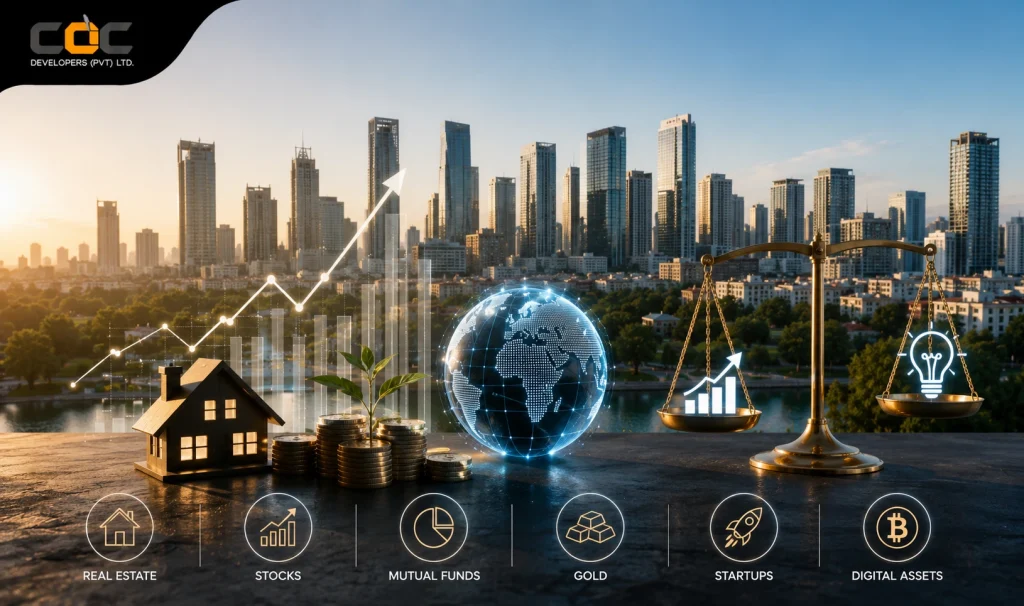
Real estate does not have to be an investor’s only asset. Depending on individual financial goals and risk tolerance, investors may also consider businesses, equities, or fixed income investments as part of a broader portfolio. Diversification helps reduce dependence on a single asset class, which can be especially valuable during periods of market uncertainty. The goal is not to abandon real estate wealth building altogether, but to treat property as one component of a wider, more balanced investment strategy rather than the sole path to financial security.
Is Real Estate Still a Good Investment in 2026?
Yes, real estate can still be a valuable long term investment, but not every property is automatically a good investment simply because it is real estate. Location matters. Genuine demand matters. Income potential matters. The reputation and quality of the developer matters. The investor’s time horizon matters as well. Rather than buying based purely on hype or a general belief that property always goes up in value, investors in 2026 need to calculate potential returns and weigh them against realistic costs and risks before making a decision.
How Can Investors Build Wealth Through Real Estate in 2026?
Building wealth through real estate in 2026 generally involves a few practical steps. Start by defining clear investment goals and setting a realistic budget. Research the location thoroughly and compare different property types available in that area. Evaluate the rental potential of any property under consideration and check the credibility of the developer behind it. Calculate all associated costs, not just the purchase price, and think carefully about a long term exit strategy. Above all, avoid making decisions based solely on short term market hype, since sustainable wealth building tends to reward patience and careful planning over quick reactions to trends.
Conclusion:
Real estate is not necessarily losing its value as a wealth building asset in 2026. What is changing is the way investors need to approach property decisions. Successful investors are now looking well beyond simple price appreciation, paying close attention to location, rental potential, development quality, genuine demand, affordability, and long term value. For those investing in Lahore, well planned and properly developed properties can still play an important role within a diversified investment strategy. At CDC Developers, our focus remains on helping investors make informed, well researched decisions in a property market that continues to evolve.
Frequently Asked Questions
1. Is real estate still a good investment in 2026?
Yes, real estate can still be a strong long term investment in 2026, though returns depend heavily on location, developer quality, and rental demand rather than property type alone.
2. What is the best property investment in Lahore in 2026?
The best property investment in Lahore in 2026 is typically one located in a well connected, high demand area, developed by a credible builder, with strong rental or resale potential.
3. Are apartments a good investment in Lahore?
Apartments as an investment in Lahore can be a good option, particularly in well located, professionally managed developments with strong amenities and consistent tenant demand.
4. How can real estate generate wealth?
Real estate can generate wealth through a combination of property appreciation over time and recurring rental income, provided the property is chosen carefully based on location and demand.
5. Should investors diversify beyond real estate?
Many financial experts suggest diversifying beyond real estate into other assets such as equities or fixed income investments, depending on individual goals and risk tolerance, to reduce overall portfolio risk.